Author: Michael Platt

  • The Different Parts of an Engagement Ring

    The Different Parts of an Engagement Ring

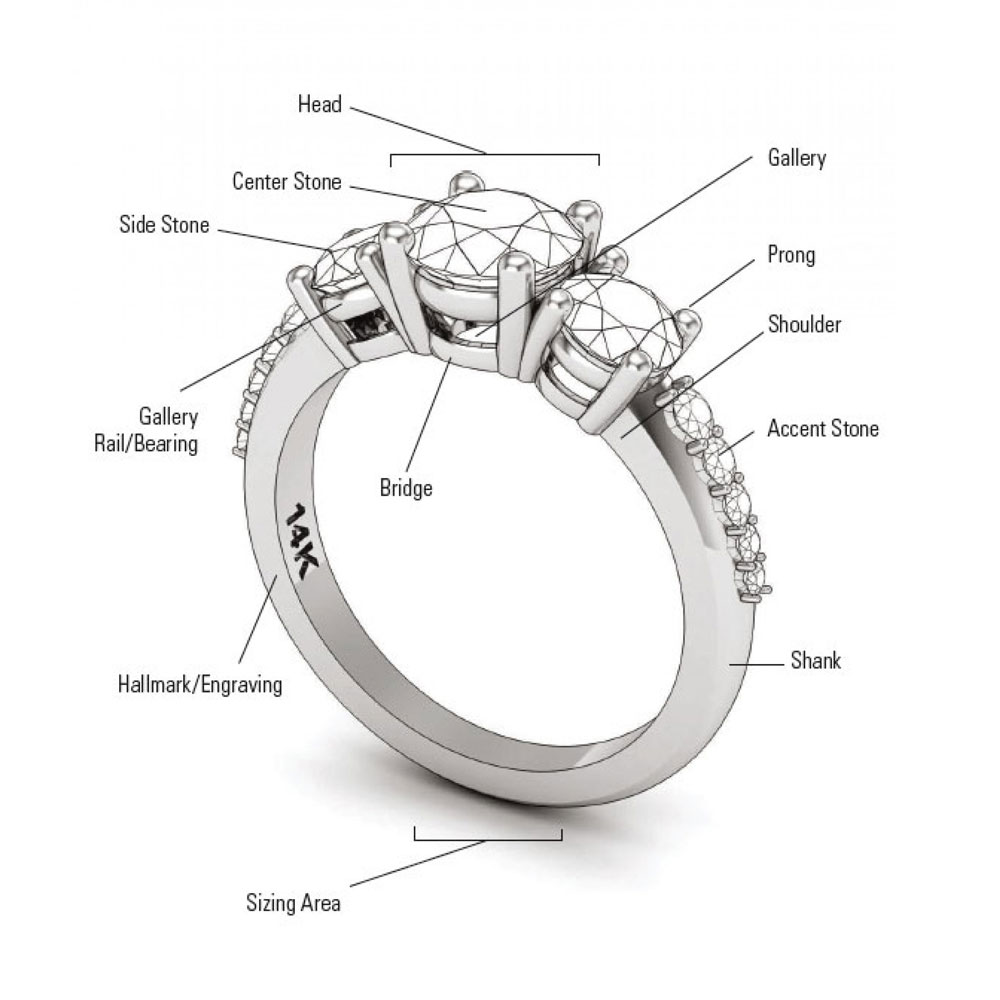
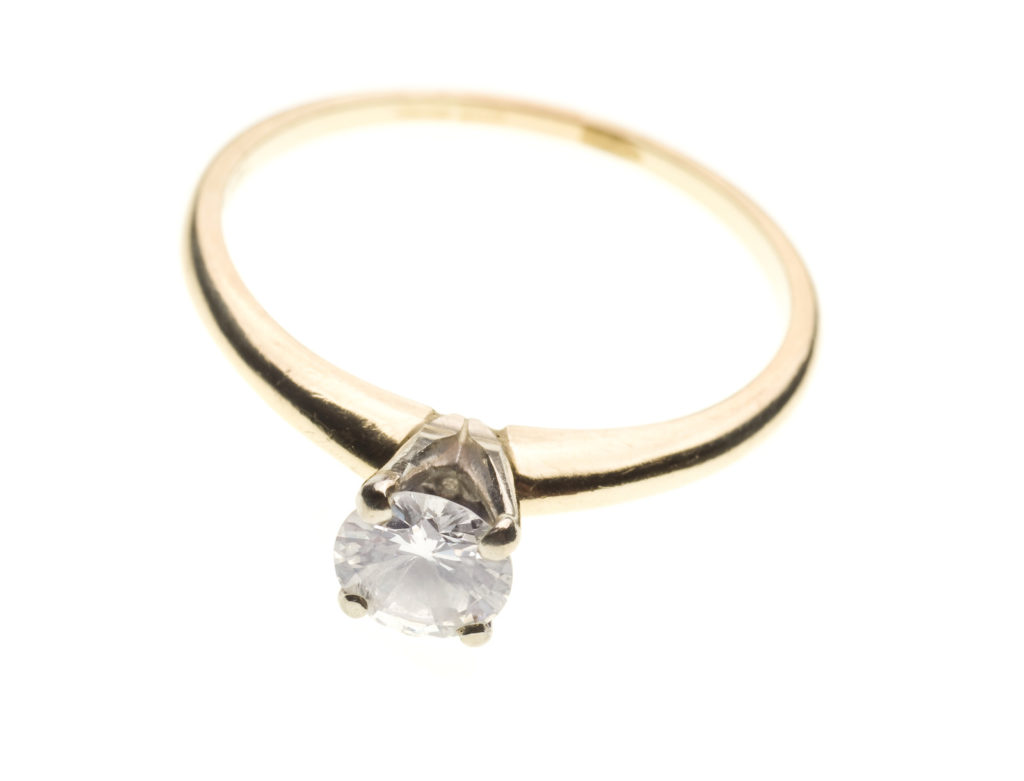
    When it comes to engagement rings, there are many different components to this small piece of fine jewellery. If you are currently looking for a ring, you may find yourself coming across a variety of terms that you have not come across before, and this can get a little confusing. To make the process easier to understand, here are what some of the main parts of an engagement ring are:

    Mount

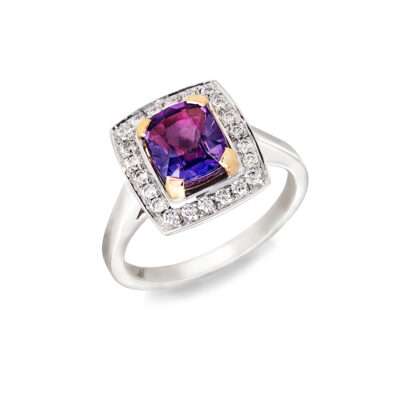
    Sometimes also known as the Setting, this term refers to the entirety of the ring (without the stone) and it can be plain or set with gemstones, or diamonds of your choice.

    Side stones

    Simply put, side stones refer to any other diamonds or gemstones in the ring that are not the centre stone.

    Shoulder

    The shoulders are the sides of the mount and lead up to the ‘Head; shoulders are sometimes set with stones.

    Head

    This is the setting that holds the diamond or gemstone.

    Claws

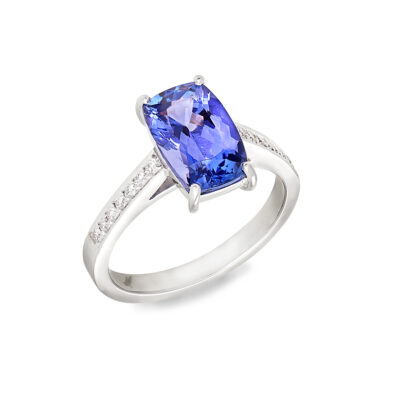
    Claws or ‘Claw Set’ refers to a popular type of stone setting style. A claw is an individual piece of metal, bent over the top to keep the gemstones or diamonds in place.

    Tips

    Tips refer to the very top of the claws, which are bent over the diamond or gemstone As claws are usually susceptible to wear and tear, they sometimes need to be re-tipped or rebuilt by a professional and expert Goldsmith. If the claws have been particularly worn down, it may be recommended to put a complete new head on the ring.  It is advisable to have your jewellery regularly inspected by a good working Goldsmith. Read more here for jewellery restoration.

    Rub Setting

    Rub setting or rub-over setting is an alternative to claw setting where the stone is completely encased by metal; gold or platinum, or can be partly encased ie half rub set.

    The gallery

    The gallery refers to the part of the ring that is visible from the side, just under where the gemstone or diamond is set.

    Band

    Otherwise known as the shank this is simply the part that wraps around the finger and will be sized for a perfect fit.

  • Why consider designing a unique piece of jewellery?

    Why consider designing a unique piece of jewellery?

    Not sure where to start or whether to make this journey but would like to really take someone’s breath away and surprise someone special with an amazing piece of jewellery unique to them?

    If you would love to give a very special lasting and memorable individual engagement and wedding ring, an exceptional Christmas, birthday, wedding or anniversary gift, then take delight in having a unique bespoke piece of jewellery made. We can help and guide you to discover exactly what type of jewellery suits and the designs which will appeal.  There are so many possibilities and our experienced designers will assist in narrowing down all choices to create an ideal beautiful piece of jewellery that will match the occasion, lifestyle and budget.

    Commissioning a bespoke item of jewellery gives you, the customer, a wonderful  opportunity to take part in designing a truly original piece of jewellery that directly reflects the personality of the individual. A splendid piece of jewellery that celebrates a special time, a memorable event or captures just a moment, is eternally everlasting and enduring. Once given, the occasion or reason is never forgotten; the piece will always mean so much more, evoking the joyful surprise in receiving it and the care, time and thoughtful effort put in to creating the beautiful piece of bespoke jewellery.

    An in-house Designer and working Goldsmith will be hands on in dealing directly with you, designing and actually making your jewellery too. The team here at Michael Platt are accustomed to working closely with customers, interpreting  and translating thoughts, sketched ideas or doodles into wonderful jewellery.  Whether working on a totally brand new piece or the redesign of dated, worn out or inherited jewellery, it is a truly exciting journey that does not need to be complex or necessarily expensive.

    The process begins with an informal chat, an exchange of ideas, preferences, styles, special dates, words or names, stones, precious metals and, of course, budget.

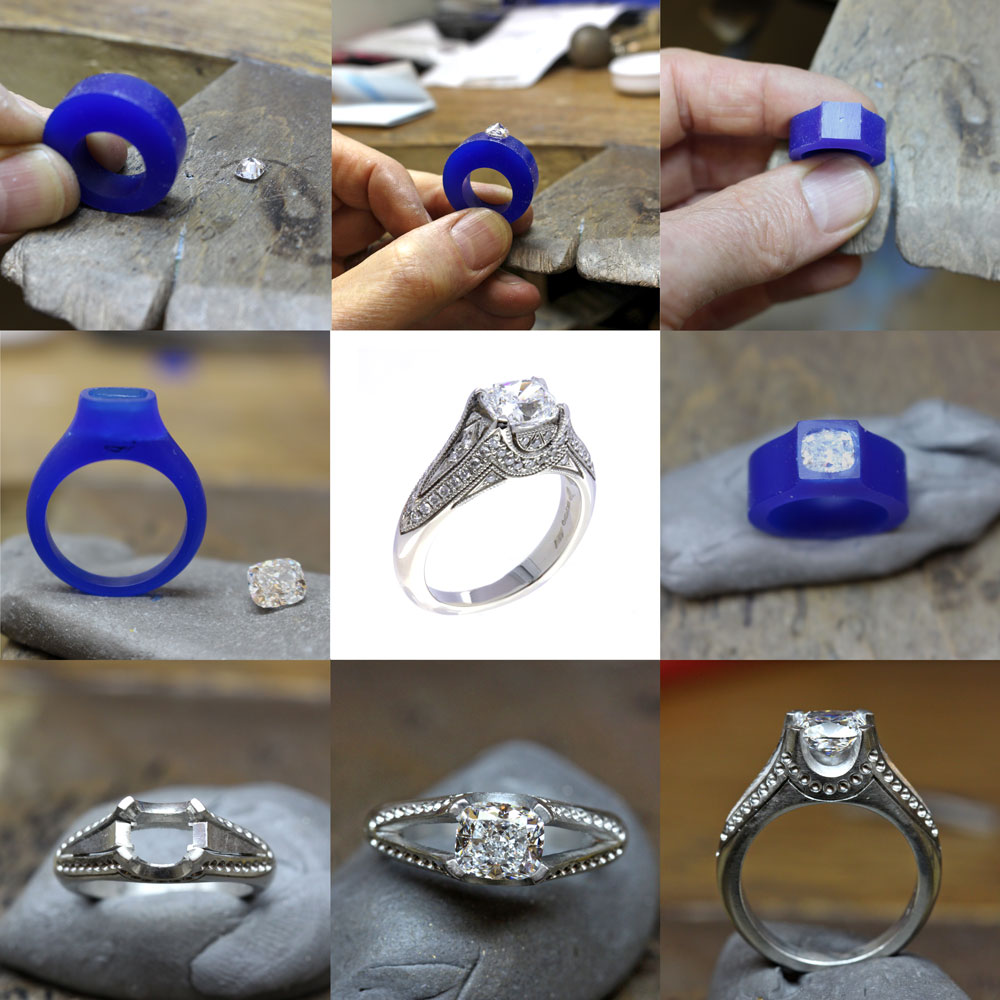
    On the return visit, customers are presented with a selection of hand drawn or 3D computer modelled designs, to discuss and choose from and, if needed, a variety of gorgeous gemstones or sparkling diamonds to select from. Customers are encouraged to be involved at every stage, much like a dress design and fitting, and can return to view the progression of their item as it evolves if time permits. Traditional hand-crafted methods are used in the in store workshop to create your bespoke piece of jewellery. This can start with freely hand carving the item in wax to be cast in the chosen metal. Once the item is formed, it will be quite ‘rough’. It is then cleaned, refined and polished and Hallmarked by the London Assay Office. The final workshop process is the setting of stones – a fine, delicate and precise process. The end pleasure for the team is when the customer collects the finished item with true wonder and pleasure.

    Having something that no one else has is very special. If you would like a bespoke piece of jewellery for yourself or for someone exceptional in your life, do pop into us at the shop, with or without an appointment, for a chat about your ideas. There is absolutely no charge or obligation for an initial consultation or drawings. In fact, if the project is confirmed, the only charge will be a 50% deposit to begin the process. The time scale for creating a piece of Bespoke Jewellery, depending on the complexity of the item following agreement of designs and stones is  a minimum of 4 weeks.

    Bespoke jewellery is not something simply ‘owned or just worn’ it is becomes dearly cherished, appreciated and prized. With just a little extra thought and effort, along with our expert professional input, an outstanding brilliant piece of jewellery can be created; a future family heirloom to pass on.

  • The meaning behind the Michael Platt Dove

    The meaning behind the Michael Platt Dove

    The Dove has been a prominent symbol above the front door of our shop in Church Road, Wimbledon Village SW19 for nearly 30 years.

    Doves are closely associated with love and peace. The dove was singled out to represent romance because Greek mythology associated the small, white bird with Aphrodite, the goddess of love (known in Roman mythology as Venus). Aphrodite/Venus is often depicted with doves fluttering around her or resting on her hand. Doves also represent monogamy and loyalty in relationships excellent qualities for marriage because they tend to stay with the same partner.

    Doves belong to the Columbidae family, which is the family of pigeons. They have a round and a stout body, short neck and beak and are strong birds. They are excellent navigators, which also makes them capable of delivering messages. Apart from these traits, they are extremely popular, and are often associated with strong emotions.

    They raise their young ones with great care and dedication. They build their nests in areas near human settlements. In a way, this may have given people the opportunity to witness the immense love, care, and loyalty displayed by white doves. People quickly associated doves with peace, love, and dedication. In fact, their reputation as symbols of love is so strong that many love potion recipes popular during medieval times required the heart of a dove!

    In ancient Aztec culture, the Goddess of Love, Xochiquetzal, considered the mother of humanity who gave the world the gift of speech and languages, is believed to have descended on Earth in the form of a dove after the Great Flood.

    In Hindu mythology, Kamadeva-the God of love-is known to ride a dove bird. This may also be another reason why doves are associated with love.

    Doves are referred to as the symbol that defines the presence of God. The Biblical story of Noah’s Ark truly defines the symbolism of white doves with peace. As per the story, after the Great Flood, Noah sent out a white dove to see if there was any land. The dove returned with an olive twig its beak, which meant that it had found dry land somewhere. This brought relief to Noah, who had spent almost a year on the ark. Since then, a white dove with an olive twig in its beak is considered symbol of peace.

    The dove is truly a bird that has touched the human mind and heart. It has inspired mankind with its innocence and purity. It reminds people of the very basic traits to live a fruitful life filled with love in peace!

    Dove Symbolism and Meanings:

    • Love
    • Grace
    • Promise
    • Devotion
    • Divinity
    • Holiness
    • Sacrifice
    • Maternal
    • Ascension
    • Messenger
    • Hopefulness
    • Purification

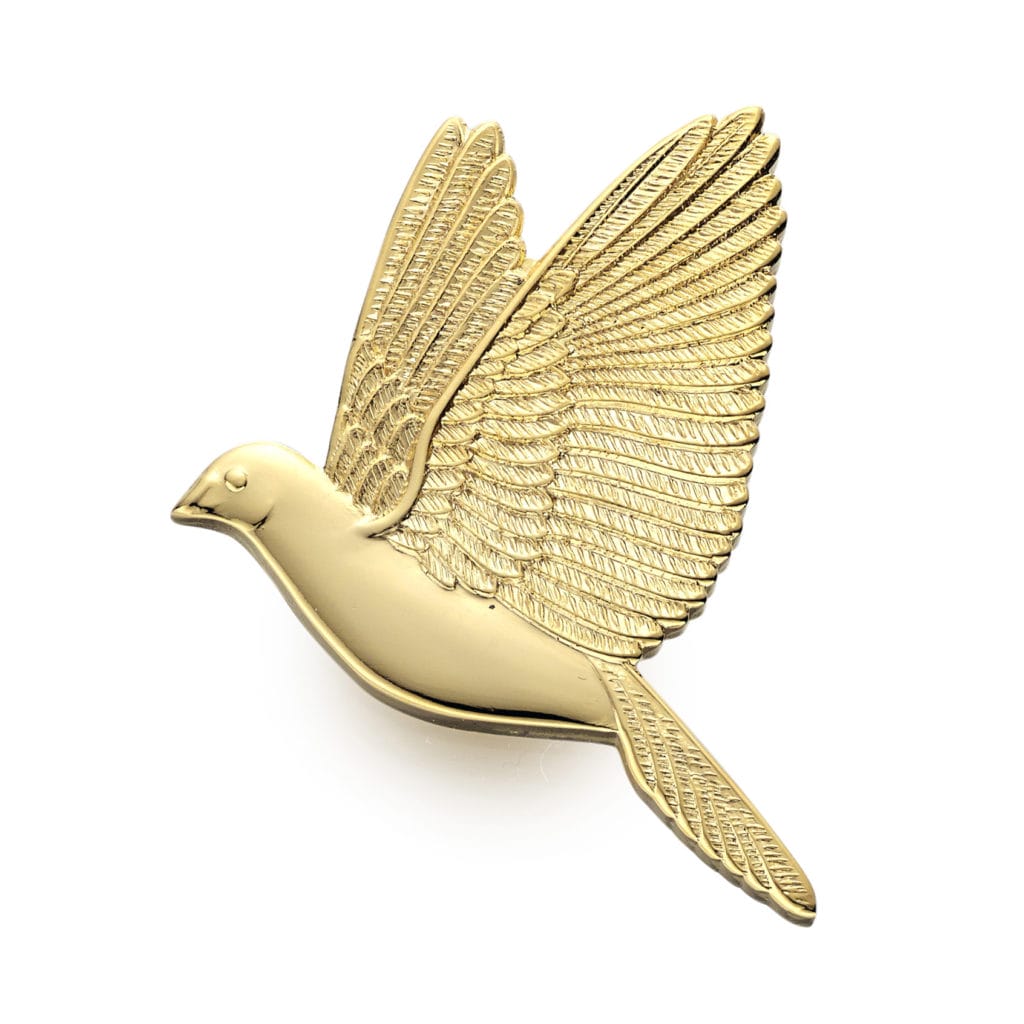
    The Michael Platt ‘Dove’ logo used on all our jewel boxes is available in yellow or white gold as a pendant or brooch.

  • What to Consider When Buying an Engagement Ring

    What to Consider When Buying an Engagement Ring

    Getting engaged is a significant life event. Trying to choose the right engagement ring often presents itself as quite a difficult task, with the pressure of finding a ring that is just right.

    Choosing a Ring

    When choosing an engagement ring it is good to take into account the needs of your partner. Such as:

    • The style of jewellery
    • Overall Style: Modern or vintage?
    • Colour of Jewellery: White or yellow metal?
    • Choice of metal: Gold or Platinum
    • Lifestyle or job which may influence the best style for practicality
    • Which stone(s) to choose: some stones are less durable than diamonds and sapphires.

    Michael Platt has been designing and creating bespoke jewellery and engagement rings for over 25 years. For more information, please contact us on info@michaelplatt.co.uk.

    Remember the four C’s

    If you are already searching for diamond engagement rings, it is likely that you have come across the term the ‘four C’s’. If you haven’t, let’s take a look at what they mean. This phrase refers to the grading of diamonds by carat, clarity, colour and cut.

    Carat – which refers to the weight or size of the stone.

    Colour – diamond colour is graded by letters with ‘D’ being topmost ‘colourless’  or white diamond colour.

    Clarity – relates to the natural inclusions or ‘birthmarks’ of a diamond, the fewer the ‘birthmarks’ the rarer the stone. We recommend a minimum clarity of SI, (slightly included) or above, the highest option being F for a Flawless stone

    Cut – this is of great importance as a diamond cut incorrectly (too shallow or too deep) can affect the brilliance of the Diamond.

    Michael Platt will guide customers through the maze of information on diamonds; giving an understanding of the four ‘C’s; Cut, Carat, Clarity and Colour.  With a little background information, effective decisions can be made to achieve that dream diamond Engagement Ring for the budget set.  Although size (carat), clarity and colour are equally important and determined by nature, it is the skill and craft of the Diamond Cutter that will actually bring a diamond to ‘life’. Michael Platt places enormous emphasis on the importance of cut and also ‘polish’; if a diamond is not cut or polished to the highest of standards, no matter what the colour or carat, it just will not have an enduring sparkle.

    Insurance policies

    An engagement ring is a valuable piece of jewellery. With this in mind, it would be wise to consider insurance. You will usually need proof of purchase or a valuation in order to obtain an insurance policy.

  • The History of The Engagement Ring: 1900s to Today

    The History of The Engagement Ring: 1900s to Today

    The giving and receiving of an engagement ring is a serious milestone in your relationship. Although ancient Egyptian mummies have been discovered with metal bands on the third finger of their left hand, the first recorded proposal with a diamond ring was in 1477, and by the end of the 19th century, engagement rings set with the best gemstone that the groom could afford were a regular sign of a couple’s intent to marry. However, just as with fashion, trends in engagement rings have varied drastically over the years and engagement rings are no exception.

    1900’s

    At the start of the 1900’s, the majority of brides-to-be that received engagement rings were members of the upper class. The most popular style was a simple band of gold, set with a European cut diamond or similar precious stone.

    1920’s

    Engagement rings in the 1920’s were reflective of the Edwardian style. The bands were larger and designed with intricate and ornate filigree metalwork that looked very much like lace. The stones were still predominantly round, European cut and added an elegant sparkle to the extremely glamorous design.

    1930’s

    By the 1930’s engagement rings had evolved to embrace larger, geometric, art deco styles that were popular in the period. Although round stones were still the most popular, they were set in unusual ways and often surrounded by other semi-precious stones.

    1940’s

    Metal rationing during WWII meant that engagement rings were often made of lower quality metals, but 1947 saw the rebirth of the diamond as the premier choice of stone for engagement rings thanks to a marketing campaign by South-African-based cartel De Beers Consolidated Mines Ltd (now known as De Beers). Their slogan ‘a diamond is forever’ marketed diamonds as an unbreakable symbol of love, highlighted them as worn by celebrities and the elite classes, and pushed the popularity of diamonds off the scale for the remainder of the century.

    1950’s

    White gold and platinum made a reappearance in the 1950’s, with round solitaires continuing their reign of popularity. This time however, side stones added to the wow-factor and reflected much of the glamour that was seen on the big screen during this decade.

    1960’s

    The 1960’s saw the emergence of a variety of new shapes of stone. Pear marquise, heart-shaped and emerald cut diamonds were in abundance, as well as some elaborate settings all within predominantly yellow gold bands.

    1970’s

    Yellow gold continued to be the metalwork of choice for engagement rings in the 1970’s, but designers chose to ramp up the glitz and quantity almost always took precedence over quality. Large radiant cut diamonds surrounded by a whole heap of smaller gemstones were very popular, as were flower-shaped clusters.

    1980’s

    The 1980’s saw white gold and platinum becoming just as desirable as yellow gold again. Round stones maintained their popularity, often enhanced with rectangular baguettes on the sides. However, the 12-carat oval blue Ceylon sapphire, surrounded by 14 solitaire diamonds and set in 18-carat white gold worn by Princess Diana when she became engaged to Prince Charles set an immediate trend and coloured stones with similar settings soon flew out of jeweller’s stores and onto the fingers of the upper and middle classes.

    1990’s

    Radiant-cut diamonds regained popularity in the 1990’s, and many were paired with triangular shaped stones on either side of them, creating a rather geometrical and modern style. White gold and platinum bands complimented the look.

    2000’s

    Taking a nod from the style of the eternity ring, in the 2000’s princess cut diamonds on a white-gold or platinum band of smaller stones was the classy yet bling-without-being-brash, engagement ring that grooms-to-be were seeking.

    2010’s

    So far this decade we have coloured stones making a serious comeback thanks to their appearance among celebrity couples. The Duchess of Cambridge is now wearing Princess Diana’s famed sapphire, and other notable figures have made yellow and pink diamonds, rubies and emeralds extremely sought-after. There are no rules when it comes to the gold, although white-gold and platinum are still viewed as more contemporary when it comes to styling.

    The Future

    Notable public figures and celebrities seem set to inspire some of the trends in engagement rings in the future, but there is one underlying desire that overshadows them – the need for uniqueness. Couples of today are seeking engagement rings that profess their love in a completely unique way and one that reflects their style and personality. Whether it is a twist on a classic design, an unusual choice of gemstone or a custom-created bespoke jewellery piece, we can expect to see an entire plethora of contemporary, vintage and blended engagement ring styles over the coming years.

  • Promise Rings

    Promise Rings

    What is a promise ring?

    The last decade or two has seen the rise of a new form of ring in American culture which is slowly crossing to the UK: the promise ring.

    There is no exact definition of what a promise ring is, as its meaning varies depending on who is wearing it and what the giver and wearer wants it to stand for. However, for the majority of couples, a promise ring is used as a symbol of love and commitment.

    In many cases, a promise ring is worn as a pre-engagement ring, and this is particularly true in the case of many young couples, for whom an official engagement may be inappropriate or unwelcome. Many people view it as the stepping stone between simply dating and becoming engaged to be married, as it acts as a physical symbol of the relationship. That said, many modern couples who have no interest in marriage instead opt for a promise ring as a sign of love and dedication to one another. Those who are in relationships following a previous marriage may also wish to make a sign of commitment to their new partner without the need for marriage, and a promise ring is a meaningful way to do this.

    Where is it worn?

    There are no hard and fast rules for how a promise ring should be worn, but the majority of unmarried people tend to wear them on the third finger of the left hand, in other words the ‘ring finger’. Those who are married, or get married at a later date often wear their promise ring on the third finger of their right hand. However, some people choose not to wear them on their hands at all and instead opt to wear them on a chain around their neck.

    Who can wear a promise ring?

    While promise rings are typically exchanged between people who are in a physical relationship with one another, there are an increasing number being exchanged between people in other types of relationships. This includes friends and family, where the wearers make a different type of commitment to one another.

    I want to give my loved one a promise ring. Do I need to get down on one knee?

    No – unless you really feel the need to! The proposal is a large part of what makes an engagement so special, so if you are planning on getting engaged at some point, we would suggest you avoid the bended knee at the time of giving a promise ring! Most promise rings are given as a gift around birthday, Christmas or Valentine’s day and are accompanied by a conversation about your commitment to one another.

    What style of ring should I buy?

    When it comes to choosing a promise ring, there is no set or acceptable style. Try and pick something that reflects your personality, and of course something that your loved one will find beautiful! You could even custom-design something so that you can give a promise of your commitment that is truly unique.

    If you plan on eventually becoming engaged then you should avoid any styles that are similar to an engagement ring, or those that would detract from it.

    Whether it is a lover, a family member or a friend, make the promise of love and commitment with a promise ring, a gift that can be treasured forever.